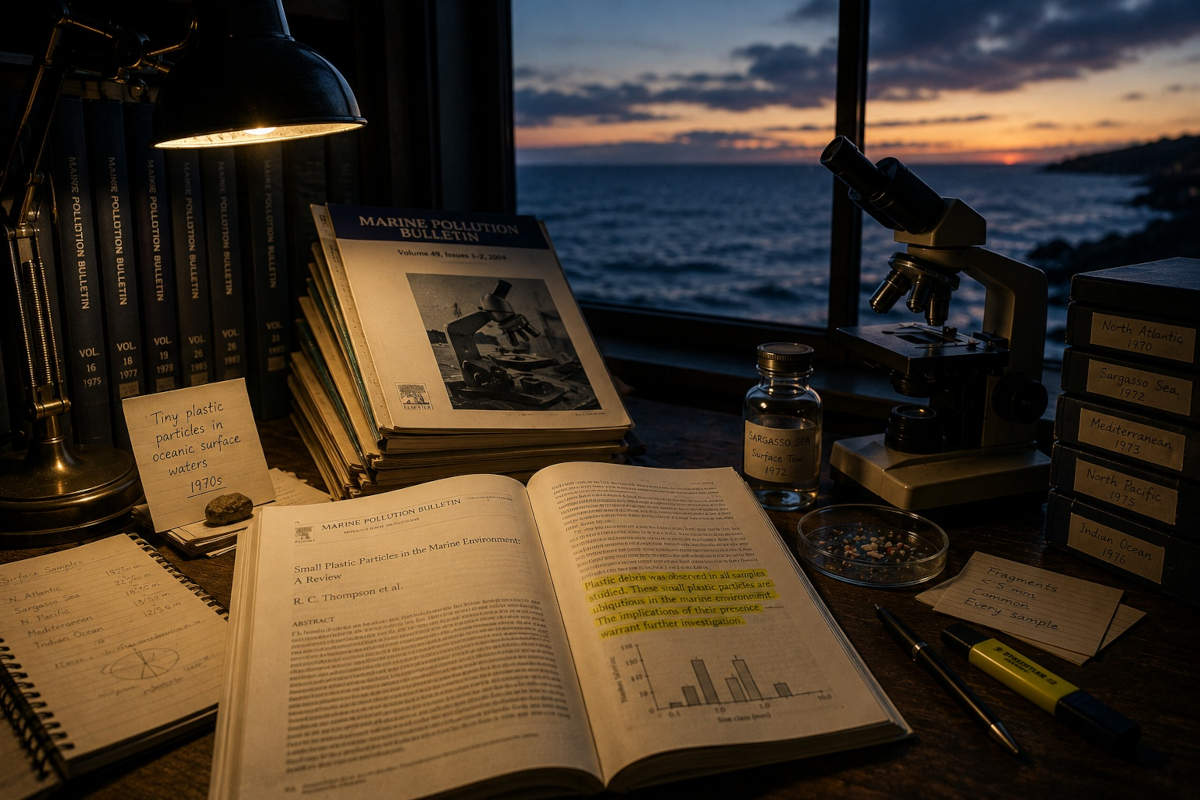
How many more of tomorrow’s crises are already sitting in today’s scientific journals?
Before microplastics became a household word…before documentaries…before headlines…marine scientists were already finding them.
By the early 1970s, researchers had documented small plastic particles floating across the Atlantic and accumulating in the Sargasso Sea. In 2004, marine biologist Richard Thompson gave these particles a name that would eventually enter the public vocabulary: microplastics.
The evidence didn’t arrive all at once. It accumulated: paper by paper, sample by sample, ocean by ocean.
For years the findings lived mostly inside scientific journals. Outside those journals, the world kept producing more plastic.
Today, microplastics have been detected throughout the environment: in oceans, rivers, rainwater, agricultural soils, drinking water, seafood, even human blood, lung tissue, and placentas. Researchers are still working out what these exposures mean for long-term health. There is no longer serious debate about whether the particles are everywhere.
What changed wasn’t the problem. It was attention.
We often imagine history’s overlooked discoveries as dramatic secrets locked inside classified files. More often they aren’t hidden at all. They’re published. Peer-reviewed. Indexed. Waiting.
The barrier isn’t access to information. It’s collective attention.
Science can identify a problem decades before society decides it deserves attention.
Microplastics aren’t the story. They’re just one of the the latest examples of a pattern we’ve seen time and time again.
Sometimes the evidence is already sitting in oblivion.
Just waiting for enough people to notice.