Funding cuts have a rhythm, too.
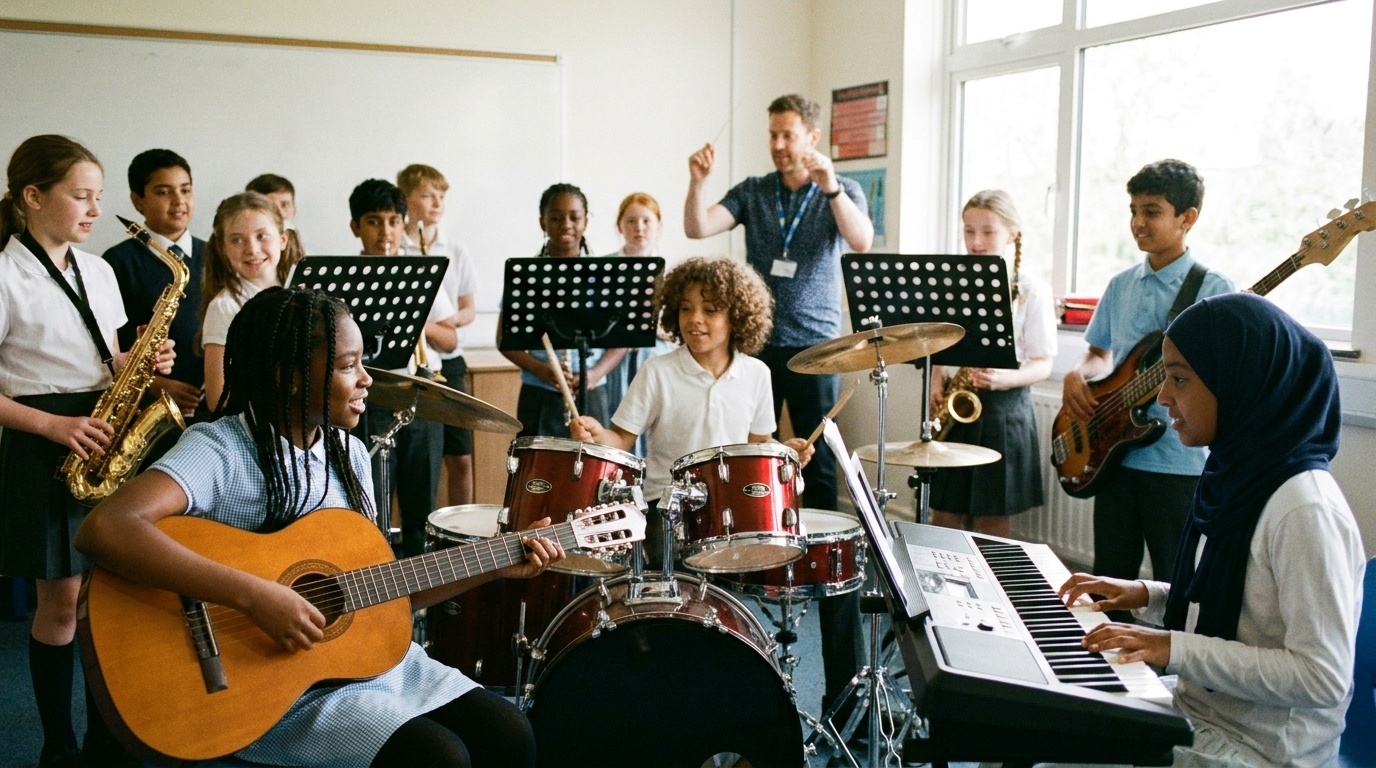
Walk into most American public schools today and you’ll find the band room repurposed – a storage closet, an overflow classroom, sometimes just empty. The instruments, if they still exist, sit in cases nobody opens. This wasn’t an accident. It was a sequence of decisions, each one defensible in isolation, that added up to erasure.
Start with the money. Education funding in the U.S. has been quietly strangled for decades – property-tax-based school financing means districts in poorer areas start behind and stay behind, while wealthier districts pad their budgets with boosters, foundations, and parent fundraising arms that can write a check for a marching band’s new uniforms without blinking. When budgets tighten, administrators don’t cut math or reading. They cut the subjects that don’t show up on a standardized test.
And that’s the second layer. No Child Left Behind, and later the Common Core era, turned “accountability” into a numbers game – schools lived or died by test scores in reading and math, so that’s where the money, the staff hours, and the institutional attention went. Music, art, shop class – anything that couldn’t be bubble-sheeted – became the slack in the system. Cut first, restored last, if ever.
Here’s the part that should bother you more: this wasn’t just bureaucratic drift. It dovetails neatly with a longer campaign to make public education look broken – underfund it, strip it down to test-prep, watch outcomes flatten, then point at the wreckage as proof that public schools don’t work and vouchers or charter alternatives are the answer. Whether or not that’s the explicit intent everywhere, it’s the functional outcome. Defund the public option, then sell its failure as the case for replacing it.
And so music becomes a luxury good. The kid whose parents can afford private lessons, a home piano, weekend ensembles – that kid is fine. The kid who would have found their instrument, their voice, their one good reason to show up to school, in a free public band room – that kid doesn’t get the chance. Access to music education is quietly re-sorting itself along the same lines as everything else: who can pay, and who can’t.
So when you hear that music class “just wasn’t in the budget this year” – ask which budget, decided by whom, and what it was traded for.