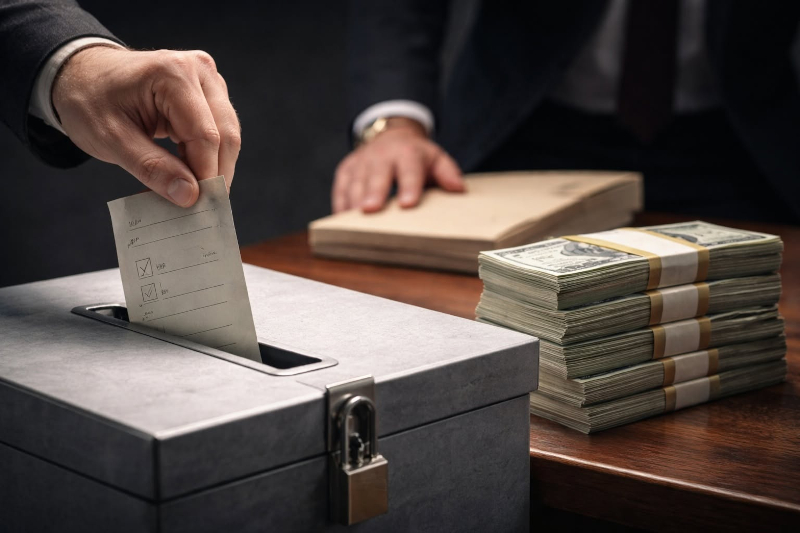
Influence was never meant to be equal. We were just told it was.
The ballot box was the fix – the one place where a steel worker and a hedge fund manager stood on the same ground. One person. One vote. The math was clean.
Then came the Powell Memo. And eventually, Citizens United.
In 1971, corporate lawyer Lewis Powell – weeks before Nixon put him on the Supreme Court – wrote a confidential memo to the U.S. Chamber of Commerce mapping out a long-game strategy for corporate America to reclaim political power: fund think tanks, capture regulatory agencies, install sympathetic voices in academia and media, and play the legislative game with patience and money. It wasn’t a conspiracy. It was a blueprint. And it worked.
Thirty-nine years later, the Supreme Court handed down Citizens United – and what the Powell Memo had spent decades building in the shadows was suddenly legal in the open. Corporations. Unions. Dark money nonprofits. Unlimited spending. No disclosure required. The ballot box didn’t disappear. It just got outflanked.
Some voices show up as votes – cast once, counted once, and then filed away until the next cycle. They register. They are tallied. And then they are largely forgotten.
Others show up as funding – and funding doesn’t stop moving when the polls close. It lobbies. It staffs. It donates again. It endows think tanks that shape the next conversation before the next election begins.
One is counted. The other compounds.
A vote is a single input on a single day. A dollar is an input that replicates – into ads, into access, into the architecture of what questions even get asked. The ballot is binary. The cash is exponential.
Over time, any system adapts to the inputs it receives most frequently.
This isn’t corruption. Not always. Sometimes it’s just physics. Water shapes the stone it runs over long enough. Policy shapes itself around the pressure applied to it – not the pressure that shows up every four years, but the pressure that never stops. The pressure that is there when the committee meets on a Tuesday morning that no one is watching.
So the old structure holds.
The scaffolding of elections, representation, rights – all of it still technically standing, still technically functioning. The machinery moves. Votes are counted.
But the messaging strains. The gap between what the system claims to be and what it demonstrably does has grown wide enough that people can feel the draft through it. Not everyone can name it. But they feel it.
And the fracture widens – not with a bang, but with a slow, structural settling. The kind that doesn’t announce itself until the day you realize the floor isn’t level anymore.