It sounds like a Daily Double clue. It shouldn’t.
“It was the largest city north of Mexico around A.D. 1100.”
What is Cahokia?
If that sounds less like history and more like a question from Jeopardy!, you’re probably not alone.
Yet around nine hundred years ago, just across the Mississippi River from present-day St. Louis, stood one of the largest cities in North America.
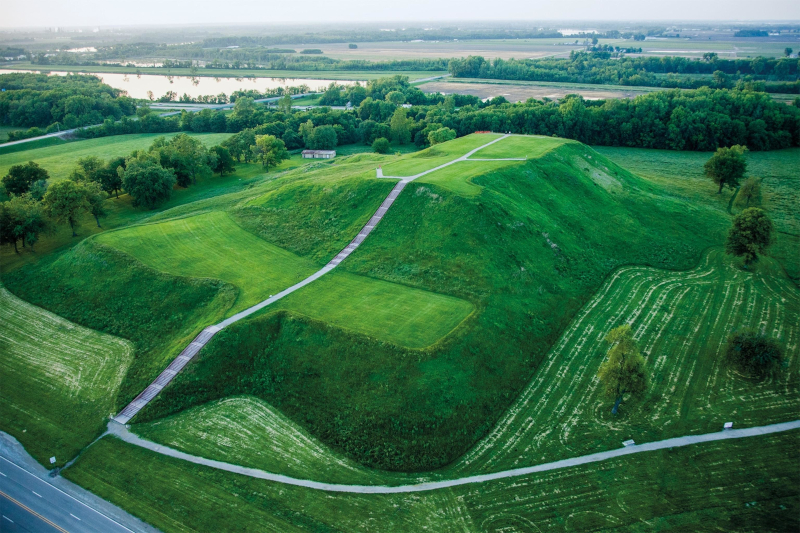
At its peak between A.D. 1050 and 1200, Cahokia may have been home to 10,000 to 20,000 people, with some estimates of the population even higher. It covered several square miles and contained neighborhoods, public plazas, defensive walls, ceremonial structures, and an immense earthen pyramid known today as Monks Mound. It also featured a circle of massive wooden posts aligned with the movements of the sun, often called Woodhenge.
This was not a temporary settlement. It was a city.
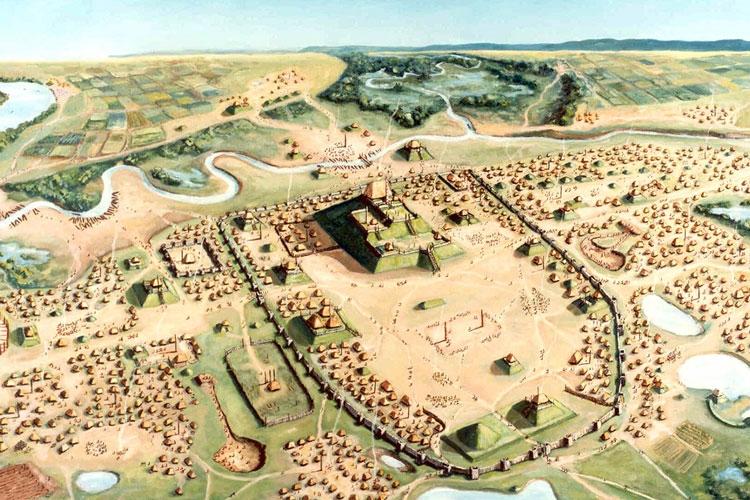
People came here from across a vast trade network stretching hundreds of miles. Farmers cultivated the surrounding floodplain. Craftsmen worked with copper, shell, stone, and clay. Leaders organized labor on a scale that still impresses archaeologists today.
At roughly the same time, medieval London may have had a similar population. That comparison is surprising.
So is the realization that Cahokia occupies so little space in our collective memory.
This isn’t an accusation. No history curriculum can cover everything, and every civilization can’t receive equal attention. But the imbalance is striking.
Most of us can identify the pyramids of Egypt. Many of us recognize Machu Picchu or Stonehenge on sight. Yet one of the most significant pre-Columbian cities north of Mexico remains largely absent from not only everyday conversation but history itself.
Why?
There are probably many reasons. It may not fit the story many of us inherited about North America before European settlement. Its builders left no written records, making archaeology our primary guide. Whatever the reason, Cahokia is rarely a topic of discussion or even thought of.
Whatever the reason, Cahokia deserves more than the occasional appearance as a trivia answer. It deserves to be remembered as one of the continent’s great urban achievements.
Sometimes oblivion doesn’t hide a forgotten footnote.
Sometimes it hides an entire city.